
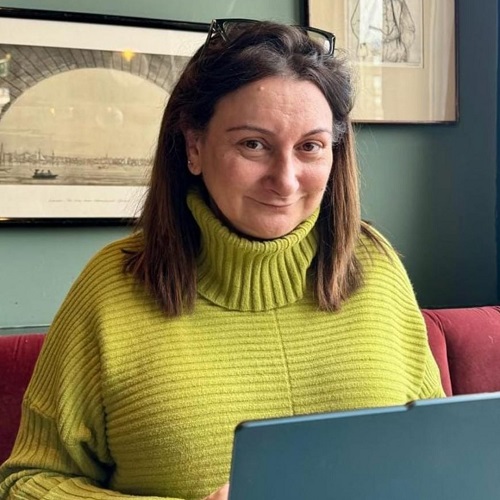
Claire Ruth Silverstone-Bright
Independent Researcher, Writer, and Advocate London, United Kingdom
Abstract Title: Living With DES: Long-Term Gynaecological Consequences of In-Utero Oestrogen Exposure
Biography:
Claire Ruth Bright, MSc, PGCert, is a writer, researcher, and DES daughter with lived experience of the long-term gynaecological consequences of in-utero diethylstilbestrol exposure. Her clinical journey includes congenital reproductive tract abnormalities, cancer surveillance, infertility, high-risk pregnancy, and menopause. She is currently undertaking a Professional Doctorate and works at the intersection of lived experience, medical ethics, and systems of care. Claire is actively involved in DES advocacy and brings a rare longitudinal patient perspective aimed at improving clinician awareness and practice. Her forthcoming memoir on DES exposure and its medical, familial, and ethical impacts is currently with publishers and scheduled for production in 2026.
Research Interest:
Diethylstilbestrol (DES) was prescribed to pregnant women between the 1940s and 1970s to prevent miscarriage, exposing millions of daughters in utero to synthetic oestrogen. While the association between DES and clear-cell carcinoma is established, the broader, lifelong gynaecological consequences remain under-recognised in routine clinical practice. This presentation offers a longitudinal patient-expert perspective on living with DES exposure across the reproductive lifespan. Drawing on lived experience alongside existing clinical literature, it explores congenital reproductive tract anomalies, cervical malformation, infertility, CIN3 and cancer surveillance, repeated gynaecological surgery, pregnancy complications including cervical incompetence, and the transition into perimenopause and menopause. Particular attention is paid to the fragmentation of gynaecological care within the UK system, where DES-related conditions are often managed in isolation rather than as part of a coherent, lifelong exposure. The burden of self-advocacy, frequent consultant changes, clinician unfamiliarity with DES, and delayed recognition of risk are examined as systemic issues rather than individual failures. The presentation also addresses the psychosocial impact of delayed disclosure, medical denial, and the cumulative effect of chronic gynaecological intervention on identity, relationships, and mental health. Emerging concerns around breast and pancreatic cancer risk are discussed in the context of declining clinical awareness and limited surveillance pathways. Finally, the talk reflects on the current national and international DES reckoning, including renewed research interest, media attention, and recent parliamentary acknowledgement in the UK. It argues for improved clinician education, trauma-informed care, and the development of clearer long-term management frameworks for DES-exposed patients. This session aims to support gynaecologists in recognising DES exposure, understanding its lifelong implications, and improving patient-centred care for a medically vulnerable but frequently overlooked cohort.